Egypt
Where the ancient past meets the modern world along the life-giving Nile.
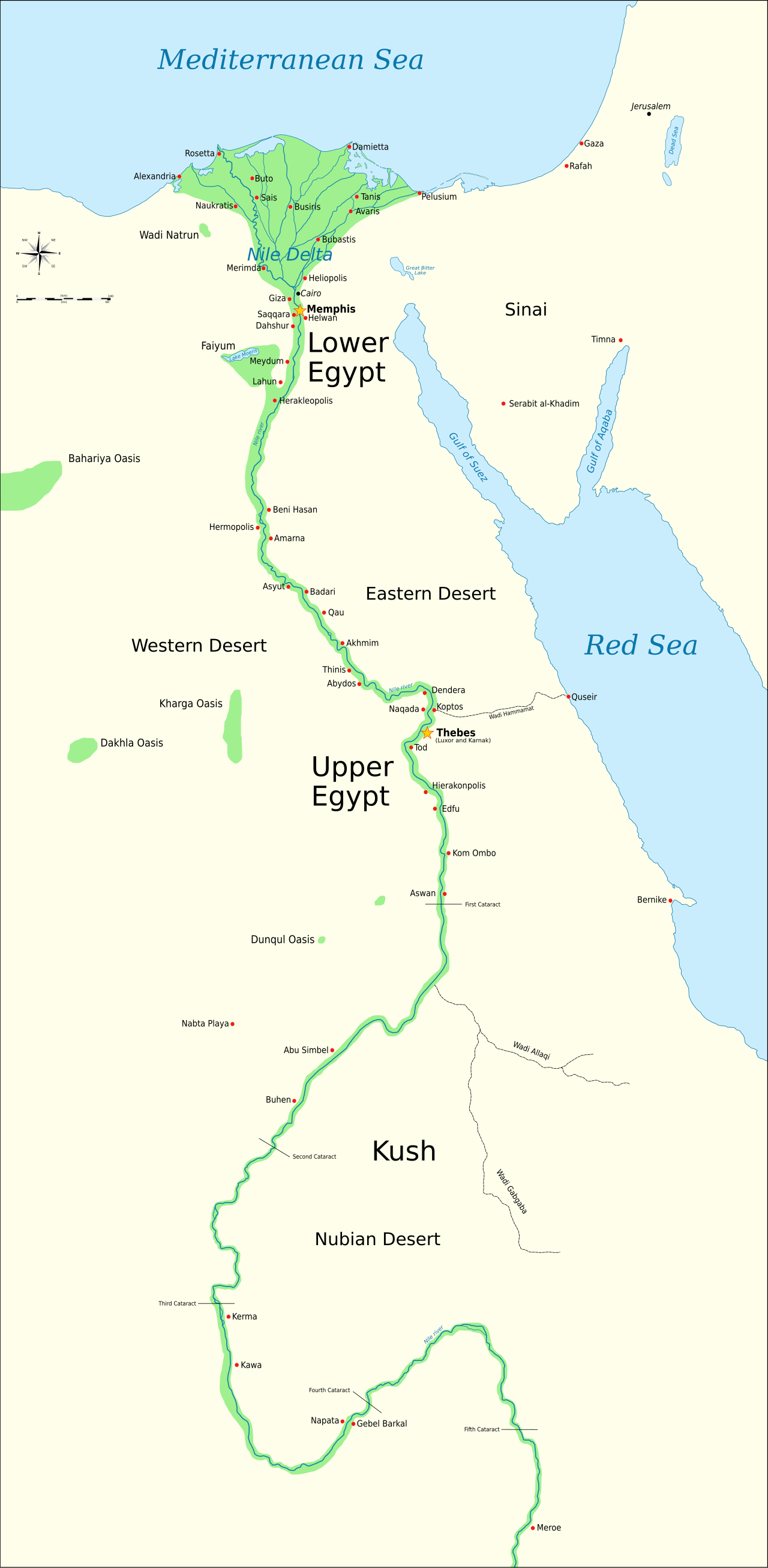
Egypt spans the northeast corner of Africa and the Sinai Peninsula in Asia, acting as a historic bridge between continents for millennia. As a cradle of civilization, it shaped global history through monumental architecture, complex faiths, and its strategic command of the Nile River valley.
- Capital
- Cairo
- Region
- Northern Africa
- Languages
- Arabic
- Currency
- Egyptian pound
- Area
- 1,002,450 km²
- Official Language
- Arabic
- Major Religion
- Islam
- Geographic Region
- North Africa / Middle East
Lore & Background
For centuries, foreign powers—from Greeks and Romans to Ottomans—held sway over Egypt until independence in the 20th century ended British occupation. Now the Arab world’s most populous nation, it breathes with layered identity: ancient heritage intertwined with living Islamic culture and Coptic Christian traditions. In Cairo, a sprawling metropolis where history isn't just preserved but lived, millennia of legacy coexist with the chaos of modern traffic.
In Their Own Story
The sun bleeds gold over the Giza plateau as the wind whispers through the limestone blocks of the Great Pyramid. An old guide pauses beside the Sphinx, his shadow stretching long across the desert sand that has shifted for five thousand years. Below, the distant hum of Cairo rises like a second river, contrasting with the eternal silence of the necropolis. Here, time does not move in a straight line; it spirals, connecting the pharaohs who built these monuments to the modern families living in their shadow.
Reader's Guide
Egypt is a land of stark contrasts: endless desert broken only by the Nile’s narrow ribbon of life. This fertile 'Black Land' united around 3100 BCE, launching dynasties that built the Old, Middle, and New Kingdoms before falling under Ptolemaic and Roman rule.
Culturally, Arabic dominates, yet the soul of the nation reflects layers of Islamic tradition since the 7th century and Coptic Christianity rooted in antiquity. Visitors trace this lineage through stone: the Pyramids of Giza, the hidden tombs of the Valley of the Kings, Abu Simbel's colossal temples, and Cairo’s labyrinthine historic quarters.
Economically, Egypt commands attention as a regional heavyweight. Beyond tourism and agriculture, its true power lies in the Suez Canal—a vital artery connecting Europe and Asia that keeps global trade flowing. Today, it remains an archaeological treasure trove where every shovel hit might rewrite history.
Did You Know?
- The Great Pyramid of Giza originally gleamed with smooth white Tura limestone, reflecting the sun like a beacon before casing stones were stripped for other buildings.
- Al-Azhar University, founded in 970 CE, stands as one of the world's oldest universities and remains a premier center for Islamic learning today.
- Completed in 1869, the Suez Canal connects the Mediterranean to the Red Sea, letting ships bypass the long voyage around Africa.
Cultural Roots and Linguistic Identity
Born in Brussels to a British mother of Christian-Buddhist background and an Egyptian father steeped in Sufi mysticism, Natacha Atlas developed a unique worldview from infancy. Her upbringing was defined by an eclectic mix of Eastern and Western traditions, with her father's deep interest in Taoism, Chinese medicine, and the Gurdjieff philosophy shaping her spiritual foundation. After moving to Northampton following her parents' separation, she navigated a bilingual environment speaking French and English before later acquiring Arabic and Spanish. This multilingual fluency allows her to perform in several languages, including modern colloquial Arabic, though she candidly admits to occasional discomfort with the dialect. Her identity is not merely a blend of nationalities but a synthesis of diverse spiritual and cultural inputs, creating a personal tapestry that directly informs her artistic expression. Rather than adhering to a single heritage, Atlas embodies a global citizen whose life story mirrors the cross-cultural fusion she champions in her music.
The Transglobal Underground Era
Atlas's professional journey began in earnest after returning to Belgium at age twenty-four, where she worked as a belly dancer and lead singer for a salsa band before entering the recording studio. Her debut came in 1989 with the Balearic beat group ¡Loca!, leading to significant collaborations with Jah Wobble and Daniel Ash of Bauhaus by 1991. It was through her work with ¡Loca! that she connected with Transglobal Underground, a British ethnic electronica band known for their Middle Eastern and South Asian influences. Joining them as lead vocalist and dancer during the height of their success with the hit 'Templehead,' Atlas became integral to their sound. This period established her reputation in the world fusion scene, blending traditional vocals with electronic beats. Her tenure with the group was not just a stepping stone but a defining chapter that honed her ability to merge disparate musical styles, setting the stage for her future solo endeavors while cementing her status as a key figure in the late 80s and early 90s alternative music landscape.
Solo Artistry and Genre Fusion
Launching her solo career in 1995 with 'Diaspora,' Atlas has consistently challenged musical boundaries, coining the term 'cha'abi moderne' to describe her modern folk fusion. Her discography, produced largely by Tim Whelan and Hamilton Lee in its early years, includes seven albums that weave together Maghrebain rhythms, hip-hop, drum and bass, and reggae. A notable surprise occurred in 1999 when her rendition of 'Mon amie la rose' climbed to number sixteen on the French charts, proving her broad appeal beyond niche world music circles. Her work extends into film and gaming soundtracks, with tracks featured in 'Sex and the City 2,' 'Grand Theft Auto: Liberty City Stories,' and Ridley Scott's 'Kingdom of Heaven.' Collaborations with giants like Jean-Michel Jarre, David Arnold, and Belinda Carlisle further highlight her versatility. From exploring jazz influences in later albums like 'Myriad Road' to revisiting classical Arabic instrumentation inspired by Rabindranath Tagore, Atlas remains a dynamic force who refuses to be pigeonholed by genre.
Advocacy and Enduring Legacy
Beyond her musical output, Atlas has been vocal about the media's treatment of multicultural artists. In the late 1990s, she expressed frustration when UK press outlets dismissed the 'multi-cultural angle' as a passing fad, arguing that such diversity was intrinsic to her identity rather than a trend. Her artistic contributions have also served humanitarian causes; notably, she contributed to the UNHCR charity album 'Voyces United.' Her music continues to resonate globally, appearing in international films like the Korean movie 'Bin-Jip' and Peter Gabriel's projects. Even as she evolved into jazz with albums produced by Ibrahim Maalouf, her connection to her roots remained strong. In 2020, she reunited with Transglobal Underground for their album 'Walls Have Ears,' touring steadily since 2021. This return signifies a full circle in her career, celebrating the enduring power of cross-cultural collaboration that has defined her path from a young dancer in Brussels to an international icon.
Gallery