Brazil
A land of endless rhythm, where the Amazon breathes and samba moves the world.
Dominating South America, Brazil pulses with the raw energy of its vast rainforests and vibrant cultural fusion. As the continent's largest nation, it acts as a critical guardian of global biodiversity while driving agriculture and renewable energy sectors worldwide.
Its identity is forged from Indigenous roots, Portuguese colonial history, and waves of immigration, creating a unique society celebrated for its rhythm, footballing prowess, and resilient spirit.
- Capital
- Brasília
- Region
- South America
- Languages
- Portuguese
- Currency
- Brazilian real
- Area
- 8,515,767 km²
- Continent
- South America
- Official Language
- Portuguese
- Largest City
- São Paulo
- Dominant Biome
- Amazon Rainforest
Lore & Background
Long before European ships appeared on the horizon in 1500, ancient Indigenous civilizations thrived across these diverse landscapes for millennia. The Portuguese arrival initiated a colonial era defined by brazilwood extraction and the tragic establishment of a transatlantic slave trade that fundamentally shaped the nation's demographics and culture. Brazil eventually declared independence in 1822, evolving from an empire to a republic, navigating periods of dictatorship before returning to democracy in the late 20th century.
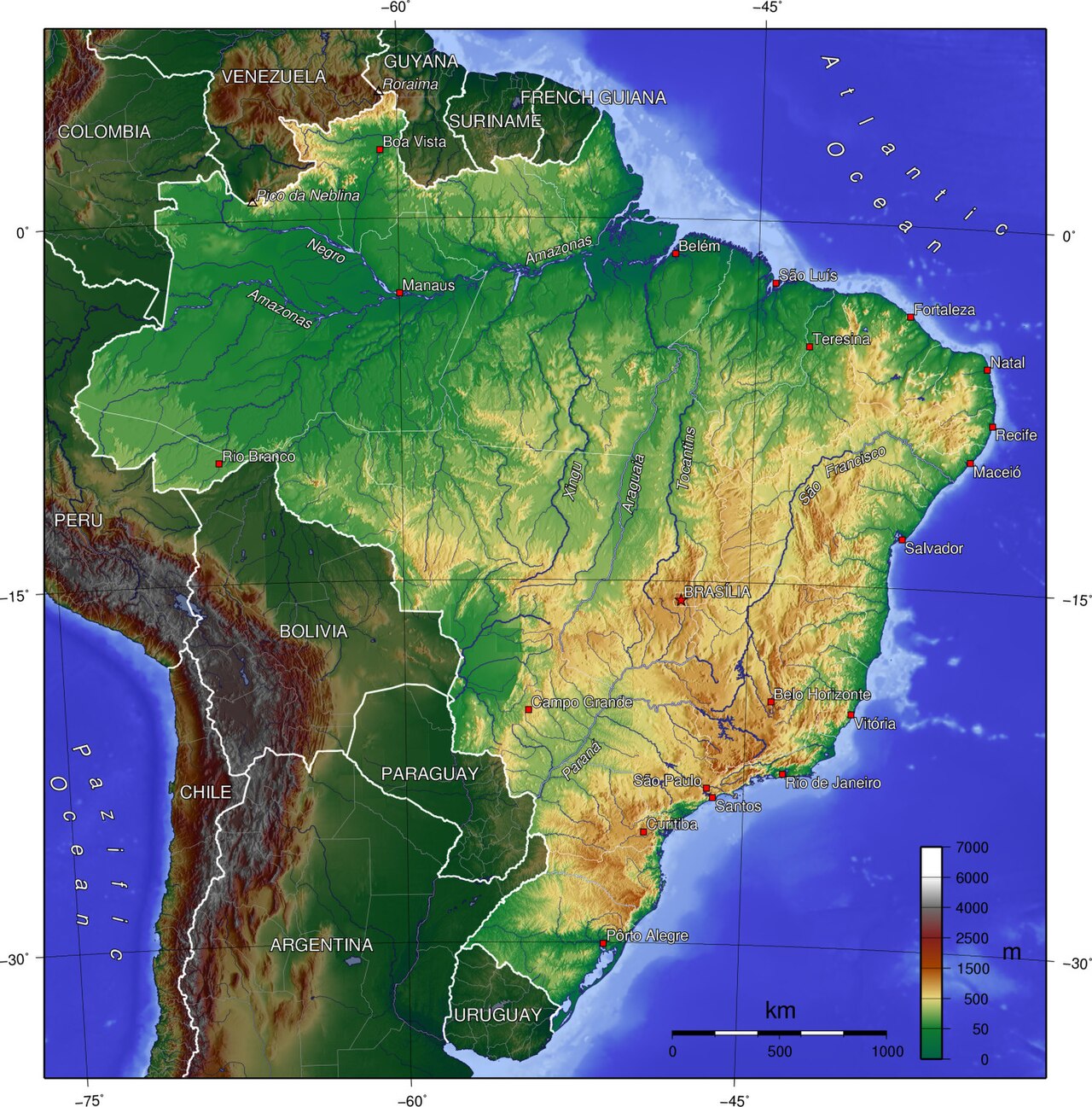
Physically, the nation spans a scale rivaling continents itself. The Amazon Basin dominates the north, holding the world's largest rainforest and river system. To the south lie fertile plateaus ideal for coffee and soy cultivation, while the northeast features arid hinterlands and stunning coastlines. This geographical diversity fostered a rich cultural mosaic where African, European, and Indigenous influences blend seamlessly in language, religion, cuisine, and art.
In Their Own Story
The humid air of Rio de Janeiro hangs heavy with the scent of salt and roasting coffee beans. As the sun dips below the horizon, painting the sky in hues of burnt orange and violet, the distant sound of a samba drum begins to pulse through the favela's winding streets. Here, on the edge of the Atlantic, life moves to an infectious rhythm that echoes from the beaches of Copacabana to the dense canopy of the Amazon far inland. A traveler stands atop Sugarloaf Mountain, watching the city lights flicker like stars against the darkening ocean, realizing that this is a land where nature and humanity dance in a perpetual, vibrant embrace.
Reader's Guide
Brazil is a nation of staggering scale and diversity, stretching from the equatorial Amazon to the subtropical south. The geography is dominated by the Amazon Rainforest, the lungs of the planet, which covers much of the north. In contrast, the central highlands host the capital, Brasília, a modernist architectural marvel designed in the mid-20th century. The southeast coast features bustling metropolises like São Paulo and Rio de Janeiro, known for their beaches, mountains, and economic vitality.
Culturally, Brazil is synonymous with Carnival, a global phenomenon of music, dance, and color. Football is more than a sport; it is a national religion that unites the population. The cuisine reflects its rich heritage, blending Indigenous ingredients with Portuguese and African traditions to create flavors as bold as the landscape itself.
Did You Know?
- Brazil is the only country in South America where Portuguese is the official language.
- The Amazon River discharges more water into the ocean than the next seven largest rivers combined.
- Rio de Janeiro was the capital of Brazil until 1960, when it moved to the newly built Brasília.
- Brazil has hosted the FIFA World Cup twice and is the only nation to have won the tournament five times.
Geography and Natural Heritage
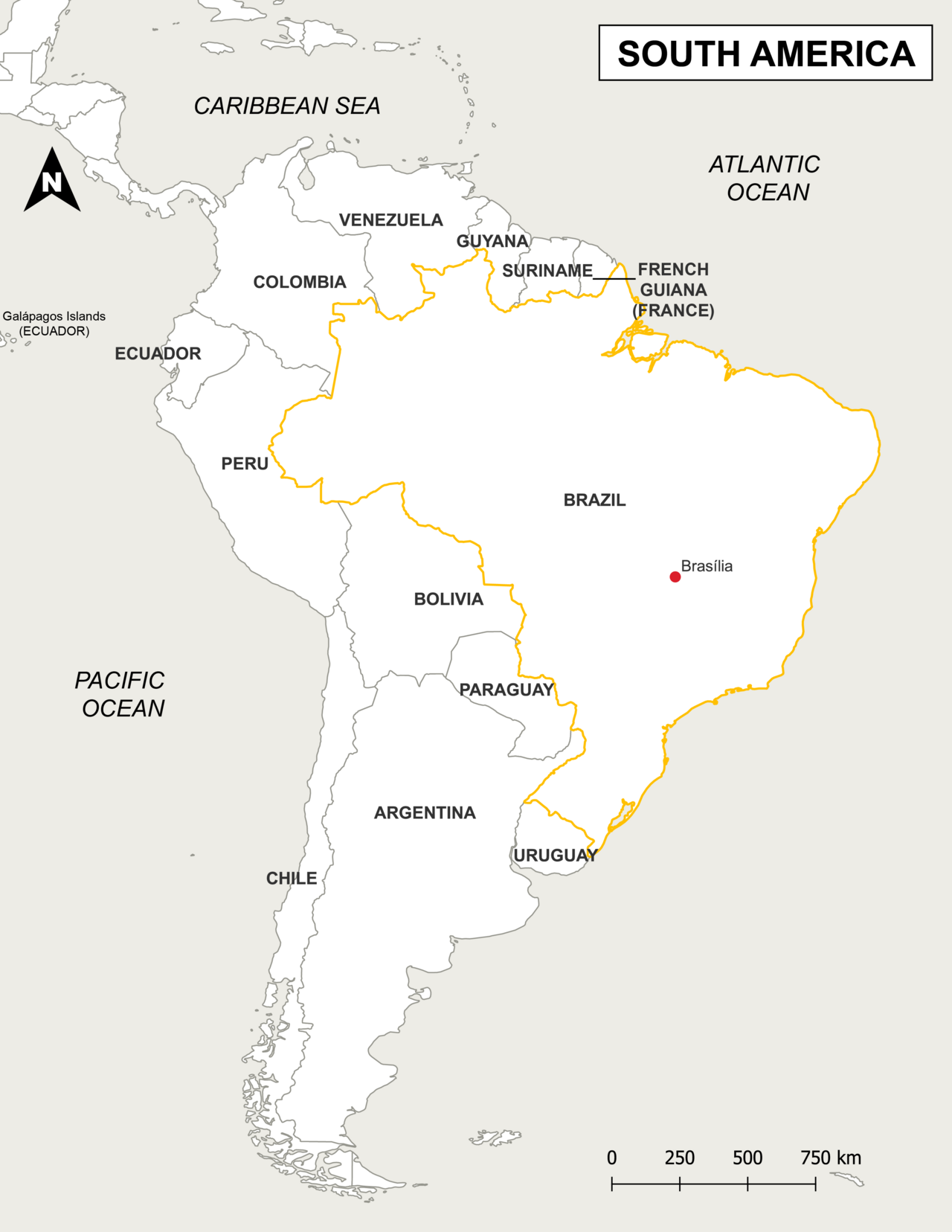
Brazil dominates South America as its largest nation, covering roughly half of the continent's landmass while ranking fifth globally by area. Bordered by the Atlantic Ocean to the east with a coastline exceeding 7,400 kilometers, it shares boundaries with every neighboring country except Ecuador and Chile. The territory encompasses an extraordinary variety of landscapes, ranging from tropical rainforests and wetlands to savannas and plateaus. Most notably, Brazil contains the majority of the Amazon basin, housing the world's largest river system and the most extensive virgin tropical forest on Earth. This ecological richness places Brazil at the top of global rankings for megadiverse nations, boasting diverse wildlife and numerous protected habitats. However, this natural heritage faces significant threats from environmental degradation, particularly deforestation, which has profound implications for global climate change and biodiversity loss. The country's vast natural resources and unique ecosystems make it a focal point for international environmental concern.
Historical Evolution and Governance
Prior to the arrival of Portuguese explorer Pedro Álvares Cabral in 1500, the land was inhabited by millions of indigenous peoples who developed complex societies and engaged in inter-tribal conflicts. Following colonization, Brazil transitioned from a colony to a united kingdom with Portugal after the royal court relocated to Rio de Janeiro in 1815. Independence was declared in 1822 by Prince Pedro, establishing an empire that eventually abolished slavery in 1888 before becoming a republic via military coup later that year. The 20th century witnessed turbulent political shifts, including Getúlio Vargas's rise to power in 1930 and his subsequent authoritarian Estado Novo regime during World War II. After a brief democratic restoration, a US-backed military dictatorship ruled from 1964 until 1985. Today, the nation operates under its current 1988 constitution as a democratic federal republic composed of 26 states and a Federal District hosting the capital, Brasília.
Etymology and Cultural Identity
The name Brazil likely originates from brazilwood, a tree once abundant along the coast that produced a deep red dye highly valued by European textile industries. In Portuguese, 'brasil' is etymologically linked to 'ember,' reflecting the wood's fiery color, though some theories suggest Asian or Arabic roots for the term. While official early records designated the territory as the 'Land of the Holy Cross,' traders and sailors popularized the name 'Land of Brazil' due to the lucrative timber trade. Indigenous names also reflect this connection; in Guarani, the land is known as Pindorama, meaning 'land of the palm trees.' Culturally, Brazil stands out as the only Portuguese-speaking nation in the Americas, home to the world's largest Lusophone population. This unique linguistic heritage distinguishes it within the Western Hemisphere and serves as a central pillar of its national identity.
Economic Status and Global Influence
Brazil functions as a major regional power and an emerging global economy, holding the distinction of being the largest in Latin America and the Southern Hemisphere. As an upper-middle-income nation with one of the world's ten largest economies, it boasts a highly diversified industrial base and serves as a primary exporter of agricultural goods, minerals, and manufactured products. The country holds significant geopolitical weight as a founding member of key international organizations including the United Nations, G20, BRICS, and Mercosur. Beyond economics, Brazil possesses immense cultural capital, ranking thirteenth globally in the number of UNESCO World Heritage Sites. Its status extends to being a major non-NATO ally of the United States and an observer state of the Arab League, underscoring its complex role in international diplomacy and its influence as a rising power on the world stage.
Gallery